Common Questions
Straight answers about sewer repair, inspection, and what to expect.
How do I know if my sewer line needs repair?
The most common signs are slow drains that don't clear with plunging, gurgling sounds from toilets or floor drains, sewage smells indoors or in the yard, wet patches in the yard when it hasn't rained, and recurring backups in the lowest fixtures of the house. Any of these warrants a camera inspection.
What does a sewer camera inspection tell you?
A push-camera inspection shows the interior condition of your sewer lateral from the cleanout to the city main. We can identify root intrusion, joint offsets, pipe belly (low spots where solids settle), cracks, corrosion, and full collapses. The video records the footage and the distance to any defect — which is what we use to plan the repair.
What is trenchless sewer repair and is my line a candidate?
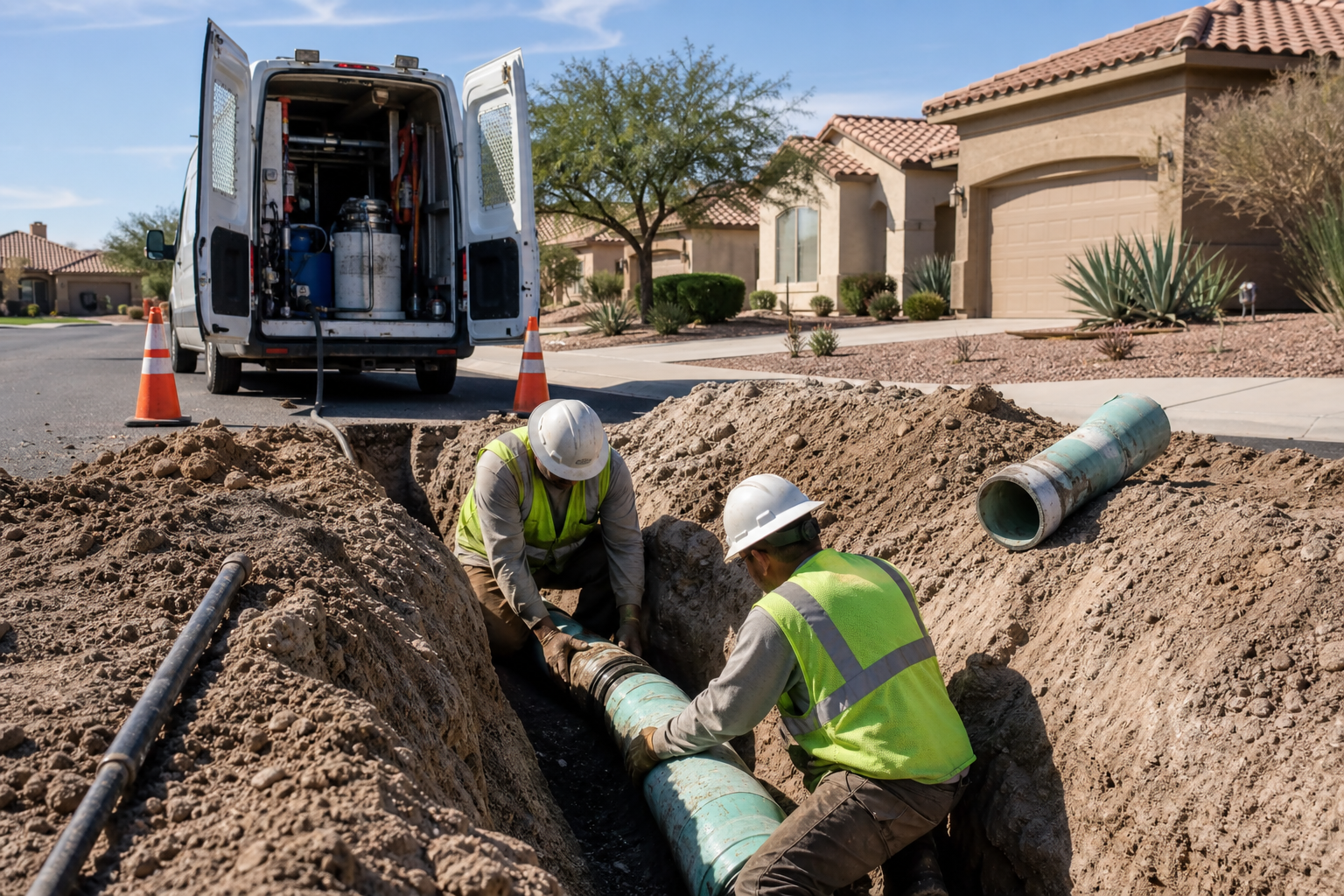
Trenchless repair (CIPP pipe lining) restores the interior of a failing pipe from the inside out — no excavation required beyond the entry and exit points. A resin-saturated liner is inverted into the pipe and cured in place, creating a new pipe inside the old one. Most pipes with intact structural walls are candidates. Pipes that are fully collapsed or severely misaligned typically are not — we check this on the camera inspection.
How long does a sewer line repair take?
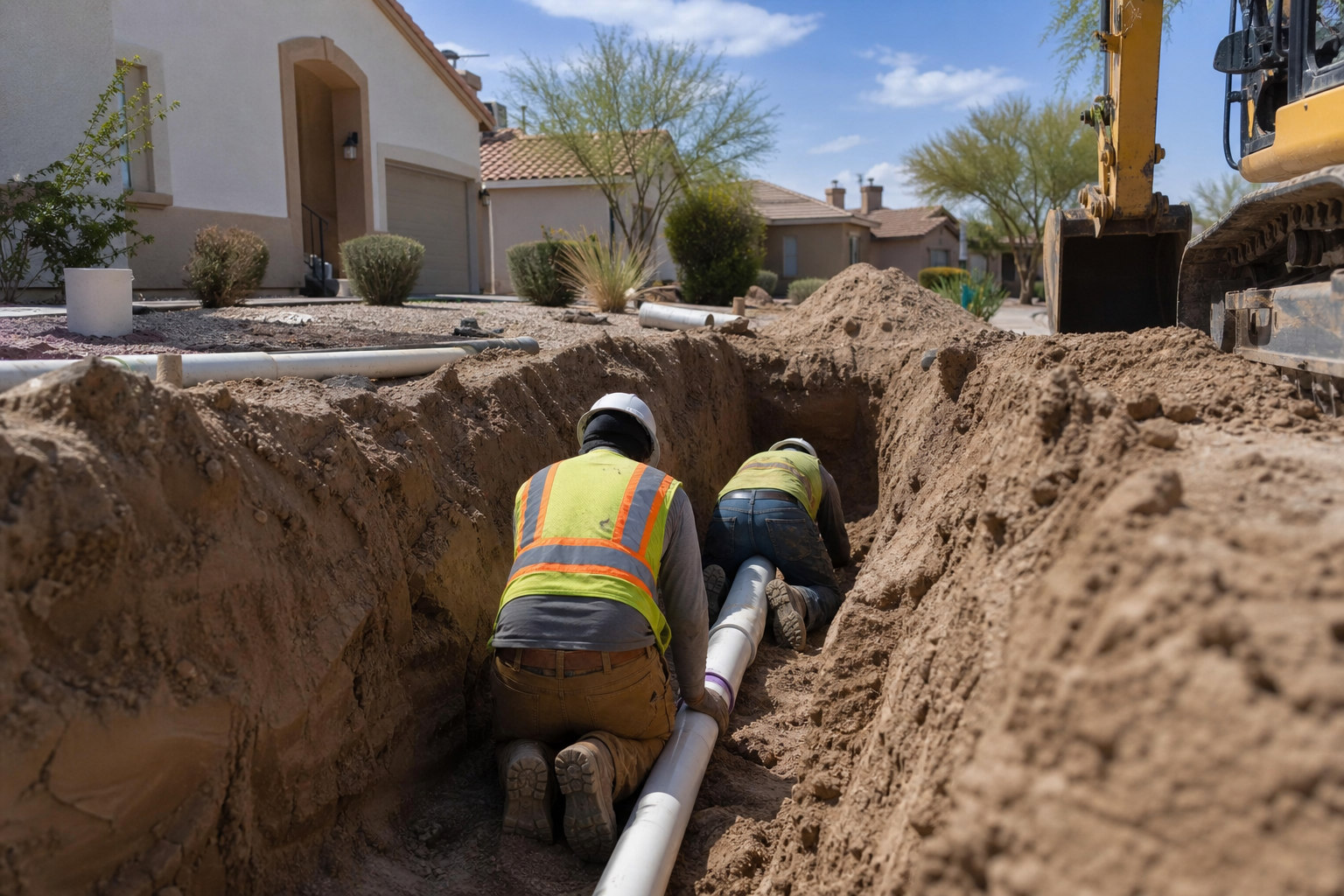
A spot repair on an isolated section usually takes a day. A full lateral replacement takes one to two days depending on depth, access, and surface restoration needed. CIPP lining typically takes a half-day to a full day. Every job is different — we give you a specific timeline before we start.
Do you pull permits for sewer line work?
Yes, on all open-cut repairs and full replacements. We pull the City of Mesa or Maricopa County permit as required, schedule the inspection, and provide you with the permit records. Trenchless lining on private lateral sections within the property may not require a permit depending on the scope — we confirm this before we start.
What's the difference between hydro jetting and a drain snake?
A drain snake (auger) punches through or retrieves a blockage but leaves grease and scale coating the pipe walls. Hydro jetting runs a high-pressure water jet at 3,000–4,000 PSI that scours the pipe walls clean. For recurring grease blockages — especially in restaurant or commercial kitchen lines — hydro jetting is the only method that actually clears the buildup rather than postponing it.
Can you repair a sewer line under my driveway without breaking the concrete?
Often, yes. CIPP pipe lining accesses the pipe from the cleanout access points at each end of the failing section, so concrete and pavers stay intact. Pipe bursting is another trenchless option that replaces the full pipe without an open trench. We check the feasibility on the camera inspection and let you know which method applies to your situation.
What causes tree roots to get into sewer pipes?
Roots enter through existing joint gaps and hairline cracks — they don't break through solid pipe. As roots grow inside the pipe, they expand and eventually block flow. In Mesa, eucalyptus, mesquite, citrus, and ficus are the most common species responsible. Older pipe materials with bell-and-spigot joints (clay, cast iron) are more vulnerable than continuous-run PVC.
Do you serve commercial and restaurant properties in Mesa?
Yes. We handle restaurant sewer lines, office building mains, retail strip centers, warehouses, apartment complexes, and HOA shared infrastructure. Commercial jobs often require after-hours or early morning scheduling to avoid business disruption — we accommodate that.
How do I handle a sewage backup that's happening right now?
Stop using all drains and toilets in the building immediately. Call us — we respond to active backups as an emergency. Don't run water anywhere in the structure. If sewage has overflowed onto floors, avoid contact with it and ventilate the space. We arrive with a pump-and-vac truck to stop the damage first, then scope the line to find the cause.
Is a sewer inspection required when buying a home in Mesa?
A standard real estate inspection doesn't include a sewer scope — that's a separate service. Given the age of sewer laterals in many Mesa neighborhoods (1960s through 1980s clay or cast iron), we strongly recommend a camera inspection before closing on any property over 20 years old. We provide the video footage and a written condition report that you can use in negotiations.
What areas beyond Mesa do you serve?
We cover the full East Valley — Chandler, Gilbert, Tempe, Scottsdale, Apache Junction, Queen Creek, San Tan Valley, Maricopa, Fountain Hills, and Gold Canyon. Call us and we'll confirm coverage for your address.
Need Sewer Line Repair in Mesa? Let's Fix It.
Mesa Sewer Line Repair responds to calls across Mesa and the East Valley. Camera inspection, same-visit diagnosis, and the equipment to handle whatever we find.